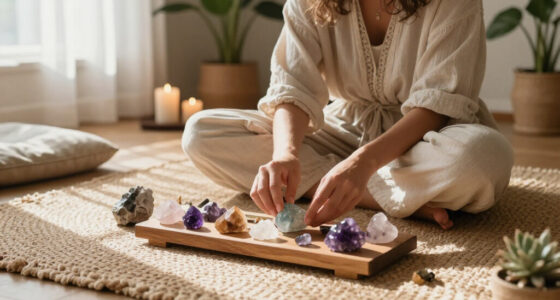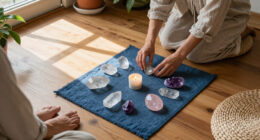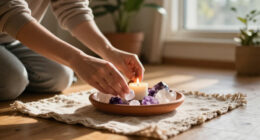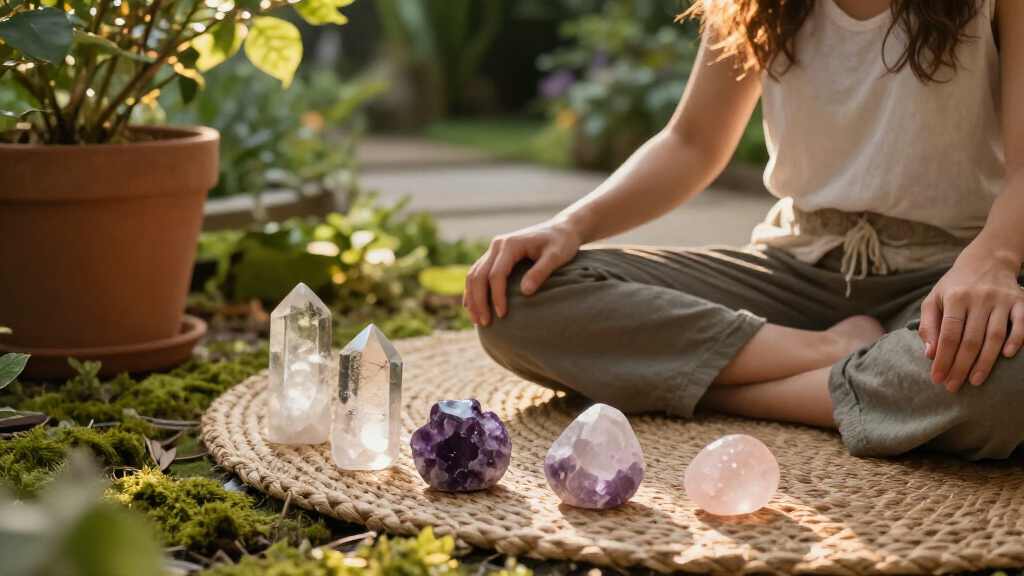
Use this guide to prepare a crystal meditation set, arrange it in a comfortable place, and complete a short meditation. It is for beginners and anyone who wants a simple, repeatable routine with stones they already own. The session takes about 20-30 minutes, including setup and a 5-15 minute meditation. Treat the crystals as optional objects for focus or personal meaning; meditation does not require them, and crystals are not a substitute for medical care.

Turn your quiet moments into listening time
- Thousands of audiobooks, podcasts and originals
- Listen on your phone, tablet or Echo — also offline
- Cancel anytime

7 Chakra Raw Crystal Set for Meditation
- ✔ Included crystals: Clear quartz, amethyst, lapis lazuli, rose quartz, citrine, tiger’s eye, and red jasper
- ✔ Stone count: 7
- ✔ Stone size: Approximately 1.4–1.8 inches each

32-Piece Natural Raw Crystal and Healing Stone Set with Guide
- ✔ Quantity: 32 crystals
- ✔ Assortment: 16 popular rough crystals and 16 specimen stones
- ✔ Typical size: Most are 1–2 inches; average size is about 1.3 inches
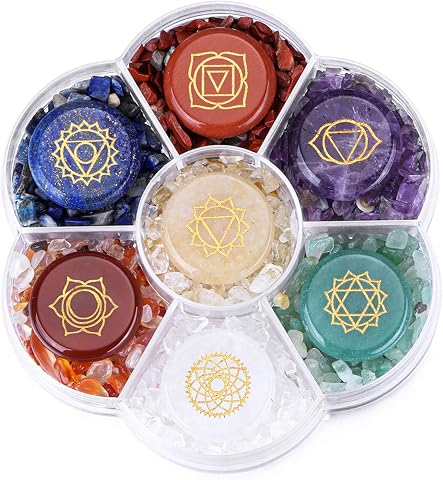
7 Chakra Natural Crystal Stone Set with Engraved Symbols
- ✔ Materials: Amethyst, clear quartz, lapis lazuli, green aventurine, yellow aventurine, red agate, and red jasper
- ✔ Stone count: 7
- ✔ Stone size: Approximately 0.98–1.02 inches each
Difficulty: Beginner | Time: 20-30 minutes, including a 5-15 minute meditation
What You’ll Need
Tools & Materials:
- One to three clean crystals or stones
- A stable surface or clear space on the floor
- A comfortable seat, cushion, or chair
- A soft cloth or small tray for holding stones
- A timer or clock
Knowledge:
- No meditation experience is required
- A basic understanding of what feels physically comfortable and safe
Set aside 20-30 minutes in a place where you can sit without interruption. If you do not know what a stone is made of, do not put it in water, salt, or direct sunlight. Some minerals can be damaged by these methods, and some are unsafe to handle when wet or dusty. You can use a dry cloth and ordinary careful handling instead.
7 Chakra Raw Crystal Set for Meditation
For a buyer who wants a defined chakra meditation set rather than a general rock collection, this is the most balanced option in the lineup. It brings together seven familiar chakra-associated stones—from clear quartz and amethyst to tiger’s eye and red jasper—in raw form. The sequence gives us a straightforward way to choose one stone at a time or arrange all seven together. Compared with the engraved tumbled set, its stones are larger and more tactile, but they lack the other set’s printed-in-stone visual markers.The wooden box and guidebook help this set work as a coherent starter kit: the box keeps the pieces together between sessions, and the guide offers introductory information and practice ideas. That pairing gives it a stronger learning-and-storage package than the 32-piece assortment, which emphasizes breadth. The raw finish also means no two pieces need feel alike in the hand, something that can make choosing a stone a more sensory ritual.There are tradeoffs. At approximately 1.4–1.8 inches each, the pieces are not the most compact choice, and raw edges may be less comfortable than polished stones for anyone who likes to hold one throughout a long session. Natural variation is part of the format, so the set may not look like a uniform display. We rank it first because it combines a focused seven-stone purpose with useful guidance and storage; buyers who want a smooth, marked set should consider the engraved option instead.
Pros:
- Seven stones associated with the chakra system create a focused meditation selection.
- Wooden box provides a dedicated place for storage or display.
- Guidebook includes beginner-friendly crystal information and practice ideas.
- Raw surfaces offer varied textures to explore during a session.
Cons:
- Natural stones vary in color, shape, texture, and size.
- Raw surfaces may be less comfortable to hold than polished stones.
Best for: People starting a seven-stone chakra meditation routine who want introductory guidance and a dedicated storage box.
Not ideal for: Buyers who need smooth, consistently sized stones for continuous handling or who want a large variety of specimens.
Bottom line: We recommend this as the strongest starting point for a guided, chakra-focused crystal meditation practice.
“We recommend this as the strongest starting point for a guided, chakra-focused crystal meditation practice.”
32-Piece Natural Raw Crystal and Healing Stone Set with Guide
This is the lineup’s broad exploration set: 32 listed varieties split between 16 popular rough crystals and 16 specimen stones. That range gives us more ways to compare color, form, and texture than either seven-stone chakra kit. It includes familiar meditation choices such as amethyst, clear quartz, and rose quartz, alongside options like lepidolite, pyrite, and rainbow moonstone. For someone building a personal ritual through experimentation, variety is the appeal.That breadth changes the experience. The seven-stone raw set arrives with a clear chakra framework, while this collection is better suited to choosing stones intuitively or rotating among them. It can also serve as a starter collection for meditation and display, so it has uses beyond a single practice. Most stones are around 1 to 2 inches, but the stated range includes smaller desert rose, garnet, and pyrite and a larger selenite piece. Size variation is therefore more pronounced than in either seven-piece set.The tradeoff is focus: 32 stones can make a beginner’s first session feel less structured, and the supplied guide does not change the fact that the set is an assortment rather than a dedicated chakra sequence. The product description also notes variation in appearance, so buyers should expect individual specimens to differ from images. We place it second because it offers the widest field for exploration, but the chakra-focused raw set is easier to put straight into a repeatable routine. Choose this one when discovery matters more than a tightly curated meditation path.
Pros:
- Includes 32 listed varieties across rough crystals and specimen stones.
- Offers both familiar meditation stones and less common specimens.
- Can support collecting, display, crafts, and meditation.
- A guide is included alongside the stones.
Cons:
- The broad assortment offers less structure than a dedicated chakra set.
- Stone sizes vary, with some specimens notably smaller or larger than most.
- Natural variation means individual pieces may differ from product images.
Best for: Curious beginners or collectors who want to sample many stone varieties and shape their own meditation approach.
Not ideal for: Anyone seeking a simple seven-stone chakra sequence, matched sizing, or a compact set with a clearly defined routine.
Bottom line: We favor this set when exploring many stones is the goal and a focused chakra sequence is less important.
“We favor this set when exploring many stones is the goal and a focused chakra sequence is less important.”
7 Chakra Natural Crystal Stone Set with Engraved Symbols
Where the raw chakra set asks us to notice texture, this one makes identification the priority. It contains seven tumbled stones with engraved chakra symbols, so the markings provide an immediate visual cue when arranging or selecting a piece. The polished format is also smoother to hold than the raw stones in the first-ranked set. At roughly one inch each, the stones are the smallest option here, making this a practical choice for a compact meditation space or for keeping the full set together in a small container.The selection still follows a chakra framework, with amethyst, clear quartz, lapis lazuli, green and yellow aventurine, red agate, and red jasper. Compared with the raw chakra set, the assortment changes some stones and emphasizes a more uniform, finished feel. Compared with the 32-piece collection, it is far easier to scan and use as a seven-part set, though it offers much less choice. The engraved symbols help keep the practice legible for newcomers who do not yet recognize stones by appearance.Its compactness brings limits. The stones measure about 0.98–1.02 inches, which may feel small to buyers who prefer substantial objects in the hand, and the included storage is a plastic box rather than the wooden box in the raw set. Natural variation still applies, and the product details specify no guidebook, so we would not choose it when introductory explanations are a priority. It earns the compact pick for its smooth finish and clear markings, while the first-ranked set remains the more complete choice for guided use.
Pros:
- Seven natural stones provide a concise chakra-focused assortment.
- Tumbled surfaces offer a smoother feel than raw crystals.
- Engraved symbols make the stones easier to identify in practice.
- Compact stones and box are easy to keep together.
Cons:
- Stones are about one inch each and may feel small in the hand.
- Storage box is plastic, unlike the wooden box included with the raw chakra set.
- No guidebook is listed in the package contents.
Best for: Meditators who prefer small, smooth stones with visible chakra labels for quick selection and arrangement.
Not ideal for: Buyers who want a guidebook, larger raw specimens, or a premium-feeling storage box.
Bottom line: We choose this set for compact, clearly marked chakra stones when smooth handling matters more than guidance or size.
“We choose this set for compact, clearly marked chakra stones when smooth handling matters more than guidance or size.”
As an Amazon Associate we earn from qualifying purchases.
Before You Start
Choose a place where the crystals cannot roll onto the floor or be reached by children or pets. Do not place stones in your mouth, on your eyes, or on broken or irritated skin. If a stone feels sharp, heavy, dusty, or uncomfortable to hold, leave it on the surface or choose another. You can keep your eyes open, sit in a chair, and stop at any time.
Step-by-Step Instructions
Step 1: Choose a quiet place
Pick a spot with a stable chair, cushion, or floor space. Silence notifications, let anyone nearby know you need a few quiet minutes, and move objects that could interrupt you. Keep the path around your seat clear so you can stand comfortably afterward.
Tip:Choose a place with ordinary, comfortable lighting. A dark room is not required, and a candle is optional; skip flames if they could be knocked over or left unattended.
Check: You can sit down and stand up safely, and the space is quiet enough for a short session.
Step 2: Select a small set of crystals
Choose one to three stones that are clean, intact, and comfortable to handle. Pick them by appearance, texture, personal association, or simply because they are available. If you are unsure what a stone contains, avoid making contact with loose dust and wash your hands after handling it.
Tip:You do not need a particular crystal type or a large collection. One familiar stone is enough to give your attention a visual or tactile anchor.
Check: Each chosen stone is easy to identify and does not have sharp edges, loose material, or a strong odor.
Step 3: Clean and inspect the stones
Wipe each stone gently with a dry, soft cloth. Check for cracks, loose chips, or residue. Put any dusty or damaged stone aside instead of rubbing it near your face. Do not soak or rinse unidentified crystals; mineral composition and treatments vary.
Tip:If you know the material is safe to wash, follow reliable care guidance for that specific stone. When in doubt, dry cleaning is the safer choice.
Check: The stones are dry, visibly clean, and comfortable to handle or place nearby.
Step 4: Arrange the set within reach
Place the stones on a tray, cloth, or stable surface where you can see them without leaning. Arrange them in a simple line or small group. If you prefer to hold one, keep the others on the surface rather than balancing them on your body.
Tip:Do not put small stones where a child or pet could swallow them. Keep the arrangement away from the edge of a table.
Check: Every stone stays in place, and you can reach your chosen focus stone without straining.
Step 5: Set a simple intention and timer
Choose a plain intention for this session, such as noticing your breathing or taking a quiet pause. Set a timer for 5-15 minutes at a comfortable volume. An intention is a focus for attention, not a promise that the crystals will cause a particular result.
Tip:If timers make you feel rushed, use a clock you can glance at or skip timing and end when you feel ready.
Check: You know what you will focus on, and the session can end without repeatedly checking the time.
Step 6: Settle into a comfortable posture
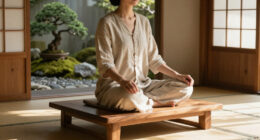
Sit with your back supported and your feet resting on the floor or cushion. Place your hands loosely on your lap, or hold one smooth stone with a relaxed grip. Let your eyes close or rest on a point in front of you. Adjust your posture before beginning so you are not forcing a position.
Tip:If holding a stone causes tension, put it down. Comfort and steady breathing matter more than keeping a pose.
Check: Your body feels supported, your hands are relaxed, and you can breathe without strain.
Step 7: Meditate with the crystals as an anchor
Notice the stone in your hand or look softly at the arrangement. Take a few natural breaths, then pay attention to the feeling of breathing in and out. When your mind wanders, notice that it wandered and return to your breath or the stone’s color, shape, or weight. Continue until the timer sounds or you choose to stop.
Tip:Thoughts and distractions are normal. You do not need to empty your mind or feel a special sensation for the session to count.
Check: You spent the set time returning your attention to a chosen anchor, even if your attention wandered often.
Step 8: Close the session and put the stones away
Take a few natural breaths, open your eyes if they were closed, and notice the room around you. Put the stones in a dry pouch, box, or shelf where they will not fall or be handled accidentally. Wash your hands if a stone was dusty or its material is unknown.
Tip:Store stones separately if they can scratch or chip one another. Keep them dry unless the care instructions for each specific mineral say otherwise.
Check: You feel steady enough to resume your day, and the stones are stored securely.
Common Mistakes to Avoid
- Choosing too many stones and spending the session deciding what each one means. — Start with one to three stones and use a straightforward focus such as breath or noticing the stone’s surface.
- Assuming every crystal can be washed, salted, or left in sunlight. — Use a dry cloth unless you have checked care guidance for the exact mineral and any treatment it has received.
- Expecting the crystals to create a specific feeling or cure a health problem. — Use the stones as optional attention anchors. Seek appropriate professional care for health concerns.
- Holding a stone tightly or sitting in an uncomfortable position to follow a routine. — Set the stone down and use a supported posture. Stop if you feel pain, numbness, dizziness, or distress.
Troubleshooting
Problem: Your mind keeps wandering.
Solution: That is common. Notice the distraction without judging it, then return to one simple anchor: the breath, the stone’s color, or its weight in your hand.
Problem: You feel uncomfortable or distracted by the stone.
Solution: Place it on the tray and meditate without touching it. Adjust your seat, lighting, or position, and end the session if discomfort continues.
Problem: A stone leaves dust, residue, or an unusual smell on your hands.
Solution: Stop handling it, place it in a closed container away from children and pets, and wash your hands. Check reliable material-specific safety information before handling it again.
Problem: You are unsure whether a stone is safe to clean with water.
Solution: Do not soak it. Wipe it with a dry cloth and look up care instructions for the identified mineral and any surface treatment.
What Success Looks Like
The session is complete when you have arranged a few clean, stable stones, sat in a comfortable position, spent your chosen time returning attention to a simple anchor, and stored the stones safely. You may feel calm, neutral, restless, or distracted; a particular mood or physical sensation is not required for a successful meditation.
Next Steps
Repeat the routine when a short pause would be useful, adjusting the session length to fit your day. Keep a note of which setup feels comfortable, and remove any stone that becomes damaged or sheds residue. Store the set dry and out of reach of children and pets. If meditation causes ongoing distress, stop and speak with a qualified health professional.
Frequently Asked Questions
How many crystals should I use?
One to three is a practical starting point. One stone is enough if you want a single visual or tactile anchor; more stones are optional.
Do I need to know what each crystal symbolizes?
No. You can choose stones by appearance, texture, or personal meaning. A crystal meditation set does not require a particular belief or interpretation.
Can I meditate without holding a crystal?
Yes. Place the stones where you can see them, or leave them aside and focus on your breath. The stones are optional props, not a requirement for meditation.
How should I clean a crystal meditation set?
For an unidentified stone, wipe it with a dry soft cloth. Water, salt, and sunlight may harm some minerals or finishes, so check care guidance for each specific stone before using them.
What if I do not feel relaxed after meditating?
Relaxation is not a required result. A short session can still be complete if you practiced returning your attention to an anchor. Stop if the practice feels distressing, and seek professional guidance if that distress persists.